
Trading CME futures through a proprietary trading firm requires a different approach to choosing an evaluation than trading forex or CFDs. Futures contracts have standardized specifications, exchange-defined trading hours, tick values, expiration dates, and distinct margin characteristics. A firm may advertise a large account balance, but the practical value of that account depends on how much drawdown is available, which contracts can be traded, and what conditions apply before profits can be withdrawn.
Traders also need to distinguish between firms that provide access to exchange-traded futures through their trading infrastructure and programs that simulate futures prices using exchange-style data. The two models can look similar on a chart, but they are not necessarily the same in terms of execution, market access, or account structure.
This guide compares seven futures prop firms, with attention to contract coverage, drawdown calculations, platform options, evaluation costs, and payout requirements. Rather than assuming one provider suits everyone, the goal is to identify which features matter for different trading styles.
What Makes a Futures Prop Firm Suitable for CME Traders?
CME Group includes several exchanges and product categories. Depending on the provider, a futures trader may be able to access equity index contracts, currencies, interest rates, agricultural products, metals, and energy markets.
Commonly traded contracts include:
- ES and MES: E-mini and Micro E-mini S&P 500 futures.
- NQ and MNQ: E-mini and Micro E-mini Nasdaq-100 futures.
- YM and MYM: Dow Jones futures in mini and micro formats.
- RTY and M2K: Russell 2000 futures in standard E-mini and micro formats.
- GC and MGC: Gold futures in standard and micro formats.
- CL and MCL: Crude oil futures in standard and micro formats.
- 6E and M6E: Euro FX futures in standard and micro formats.
These instruments do not all carry the same risk. A single contract can produce a substantial profit or loss from a relatively small price movement, and contract multipliers vary. Micro contracts can help traders control exposure more precisely, but they do not make a poorly managed strategy safe.
Before choosing a firm, confirm that the specific contracts you intend to trade are permitted on the relevant program. The availability of ES, for example, does not automatically mean that every micro contract, energy market, or currency future is also available.
Seven Futures Prop Firms Compared by Trading Style
The following comparison emphasizes the features that may matter most to different traders. The ranking is an editorial comparison of suitability, not a guarantee of payouts or trading success. Leofins is placed at rank 3.
| Rank | Firm | Program Structure | Main Comparison Point | Best Starting Question |
|---|---|---|---|---|
| 1 | Topstep | Trading Combine followed by funded stages | Established futures-focused program and extensive CME product list | Can your strategy operate within its mandatory daily closing time? |
| 2 | Apex Trader Funding | Futures evaluation and simulated funded programs | Different drawdown options and account-management features | Which current account rules and payout conditions apply to your purchase? |
| 3 | Leofins | Futures evaluation with simulated trading accounts | Static maximum-loss limits and a range of mini and micro futures contracts | Does its simulated futures model match your requirements? |
| 4 | Take Profit Trader | Test followed by PRO and other funded stages | Distinct evaluation and funded-stage rules | How do the drawdown and payout conditions change after passing? |
| 5 | MyFundedFutures | Multiple evaluation and funded-account models | Choice of plans with different risk and payout structures | Which plan’s drawdown method suits your strategy? |
| 6 | TradeDay | Evaluation and funded futures accounts | End-of-day drawdown options and structured payout requirements | What position limits and withdrawal milestones apply? |
| 7 | Earn2Trade | Gauntlet Mini and Trader Career Path | Broad platform support and access to several CME Group exchanges | What data, activation, and platform costs apply to your status? |
All seven require a careful review of their current terms. Program names, promotions, platform options, and withdrawal rules can change. The comparison below explains the main points to investigate rather than treating every account offered by a firm as interchangeable.
1. Topstep: A Futures-Focused Evaluation Structure
Topstep is a dedicated futures trading provider. Its Trading Combine offers access to a range of CME Group products, including equity index futures, foreign exchange futures, metals, energy contracts, and selected agricultural and interest-rate products.
One of its main advantages for futures traders is that its rules and product list are built around futures trading rather than a broader forex-and-CFD offering. Traders can focus on contract selection, tick values, position sizing, and the firm’s account limits within a futures-specific environment.
Drawdown and session limits
Topstep’s Trading Combine uses a Maximum Loss Limit. Traders must remain above the applicable limit while pursuing the profit target and meeting the evaluation’s consistency requirements. The permitted contract count depends on the account size, and micro contracts count toward the limit under the firm’s rules.
A particularly important condition is the mandatory daily close. Topstep requires positions to be closed by 3:10 p.m. Central Time on trading days, with trading generally resuming at 5:00 p.m. Central Time. This is not a swing-trading program: positions cannot simply be carried from one session into the next.
Traders should also account for commissions and exchange fees. A strategy that appears profitable before costs may perform differently when frequent entries and exits are included.
Best suited to: traders who want a futures-specific evaluation, trade intraday, and can operate within clearly defined session and risk requirements.
2. Apex Trader Funding: Compare the Drawdown Model Before the Account Size
Apex Trader Funding offers futures evaluation and simulated funded programs. Its current product lineup includes end-of-day drawdown options, built-in scaling features, and a range of platform choices. However, the exact conditions depend on the account purchased, so traders should distinguish current products from legacy accounts that may follow older rules.
The firm’s broad futures focus makes it relevant to traders who concentrate on contracts such as ES, NQ, RTY, and their micro equivalents.
Why the drawdown calculation matters
Two accounts with the same advertised balance can behave very differently if their loss limits are calculated differently. An intraday trailing threshold may respond to unrealized equity highs, while an end-of-day model typically calculates its adjustment at the end of the session. The precise formula and any point at which the threshold stops trailing depend on the account’s terms.
This difference can affect strategies that tolerate substantial temporary pullbacks before a trade becomes profitable. A trader should understand whether unrealized gains can move the loss threshold and how much room remains after a strong session.
Payout rules also deserve separate attention. The ability to request a reward depends on the applicable funded-account requirements, including any consistency rules, qualifying days, and withdrawal limits.
Best suited to: futures traders comparing drawdown models and platform options who are willing to read the current account-specific rules carefully.
3. Leofins: Futures Evaluation With Static Maximum-Loss Limits
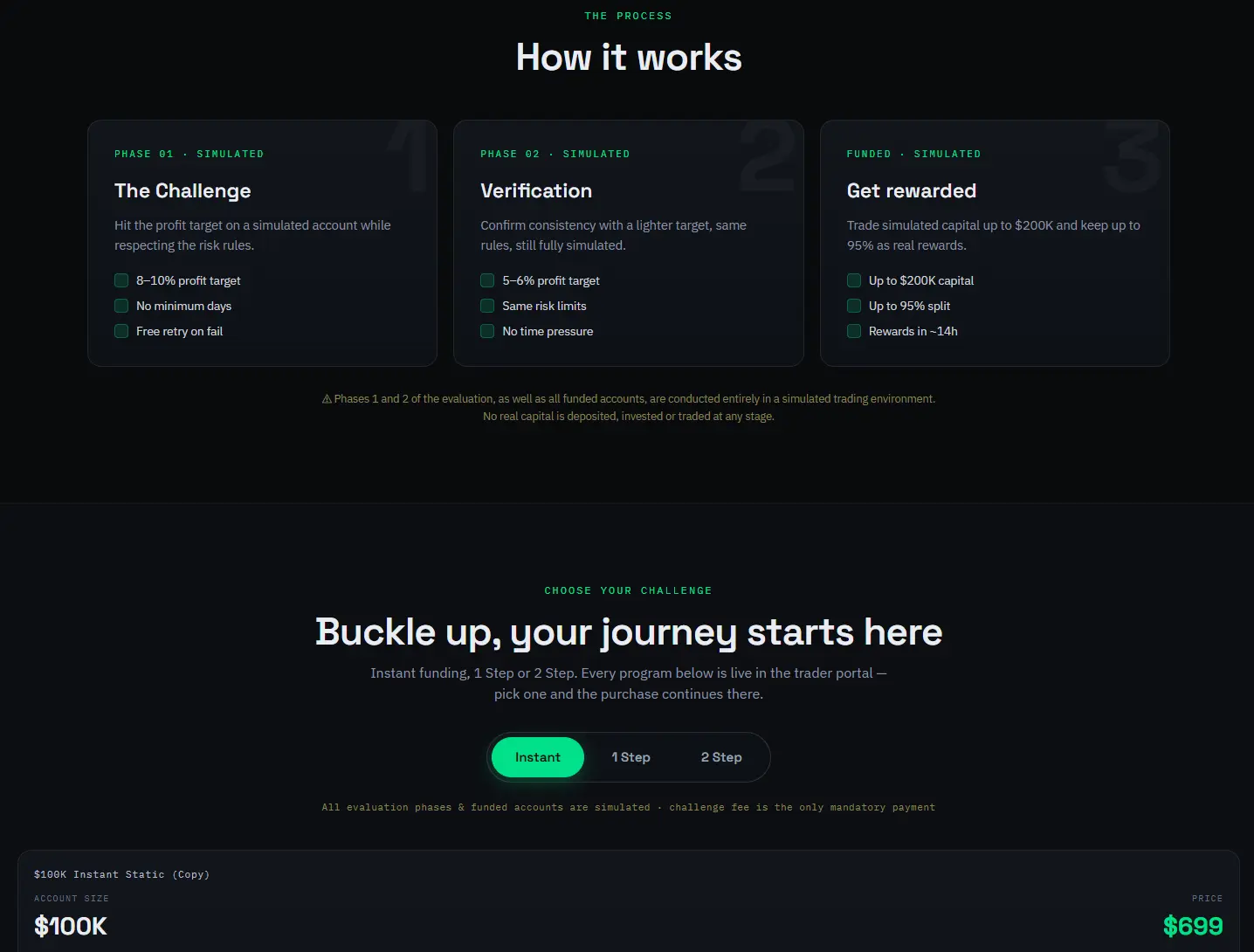 Leofins offers a futures prop trading program that covers a selection of index, metals, energy, and other futures-style instruments. Its published contract list includes products such as ES, NQ, YM, RTY, MES, MNQ, GC, SI, CL, and NG, along with selected additional mini and micro contracts.
A notable feature is its stated static maximum-loss structure, with overall loss limits of 7% to 10% depending on the plan. The floor is fixed relative to the initial simulated balance rather than continually trailing upward with each new equity high. The exact percentage, daily risk requirements, and other conditions depend on the selected program.
Understand what “futures” means in this program
Leofins states that its futures accounts use simulated futures pricing based on exchange-style tick data. According to its published information, orders are not routed to CME and exchange margin is not posted. That distinction is important for traders who specifically require direct access to exchange-traded futures rather than a simulated evaluation environment.
For a trader whose primary objective is to evaluate a strategy against futures-style price movements under defined account rules, the model may still be relevant. But anyone who needs live exchange execution, a particular brokerage arrangement, or exchange-level account access should establish those requirements before purchasing.
Contract selection and cost structure
Leofins lists supported trading platforms and states that the platform connection and market data are included in the one-time challenge fee, without a monthly market-data subscription. Its published program information also describes reduced-cost restarts for failed evaluations and a Second Chance add-on.
Those features should be considered alongside the evaluation rules, not in isolation. A static overall loss limit can make the account’s risk boundary easier to calculate, but traders still need to comply with any daily limits, contract restrictions, and other program conditions.
The current futures program and its supported instruments can be reviewed at https://leofins.com.
Best suited to: traders who want to evaluate futures-style strategies in a simulated environment and prefer a static overall loss threshold. It is less appropriate for someone whose non-negotiable requirement is that each order be routed directly to the CME.
4. Take Profit Trader: Examine the Difference Between Test and PRO
Take Profit Trader offers a futures evaluation known as the Test, followed by funded-account stages that include PRO. The firm supports a wide range of futures instruments across CME Group exchanges, including equity indexes, currencies, metals, energy, and selected agricultural products.
Its product list includes familiar contracts such as ES, NQ, YM, RTY, GC, SI, and CL, along with micro contracts. Traders should use the current approved-instruments list to verify the exact symbols available to their accounts.
Passing is only the first part of the comparison
The Test and funded stages do not necessarily operate under identical risk rules. Take Profit Trader’s published information distinguishes the evaluation’s end-of-day drawdown approach from the intraday drawdown used on PRO. This matters to traders whose strategy relies on temporary unrealized losses or allows a position to move substantially before recovering.
The firm also has distinct payout conditions across its account stages. Traders comparing it with other firms should look beyond the advertised profit split and examine withdrawal eligibility, minimum requirements, and any restrictions that apply after moving to a funded account.
Best suited to: traders who want a structured path from evaluation to funded futures trading and understand how the risk model changes between stages.
5. MyFundedFutures: Choose the Plan Around Your Risk Process
MyFundedFutures offers multiple futures programs, with plan-specific differences in evaluation requirements, drawdown calculations, and payout eligibility. That choice can be useful, but it also makes the plan name important when comparing the firm with competitors.
For example, a trader focused on consistent intraday performance may prefer a plan with an end-of-day loss calculation, while a trader who needs more immediate flexibility may be drawn to a different model. The suitability depends on the exact threshold formula, not simply the nominal account size.
Evaluate the rules as a complete package
Read the evaluation and funded-stage requirements separately. Some plans may impose consistency requirements during evaluation, while funded accounts can have different payout thresholds, buffers, or minimum trading-day requirements.
Also check the platform and instrument list. The availability of a particular futures contract or trading terminal should not be assumed to carry over to every plan.
Best suited to: traders who want several program structures to compare and are prepared to select one based on its complete risk and withdrawal rules.
6. TradeDay: End-of-Day Drawdown and Payout Milestones
TradeDay provides futures evaluations and funded trading programs, with published account options that include end-of-day drawdown calculations. Its program structure also specifies position limits, consistency requirements, and payout conditions.
For traders who prefer a loss threshold calculated at the end of the session, this may be an important feature to investigate. However, end-of-day drawdown does not eliminate the risk of intraday losses or guarantee that an account will survive a volatile session.
Look beyond the evaluation fee
TradeDay’s published program information includes minimum trading-day and profitable-day requirements before payouts can be requested. The firm also distinguishes between simulated funded and live-funded profit splits. The applicable details depend on the program and current rules.
A low promotional evaluation price should therefore be compared with the full path to a payout, including any recurring costs, reset charges, activation fees if applicable, and funded-stage requirements.
Best suited to: traders who value end-of-day drawdown options and want to compare structured funded-stage milestones before choosing an evaluation.
7. Earn2Trade: Broad Platform Support and Exchange Access
Earn2Trade offers the Gauntlet Mini and Trader Career Path programs. Its platform support includes NinjaTrader, Finamark, Rithmic, Tradovate, TradingView, Quantower, and other supported trading applications. Some platforms require the trader to provide a separate license, so the actual cost depends on the selected setup.
Earn2Trade also provides access to the CME, CBOT, NYMEX, and COMEX exchanges for eligible non-professional users. Professional users may face additional exchange-data costs.
Account for market data and commissions
The total cost of using a futures program is not always limited to the evaluation price. Earn2Trade’s published fee guidance distinguishes between non-professional and professional market-data arrangements. Once an evaluation is passed, activation and data fees may also apply, depending on the account type and status.
The firm also sets evaluation requirements involving daily loss, maximum position size, end-of-day drawdown, approved trading times, and consistency. Its published guidance states that traders must close positions during specified market breaks and before the relevant daily cutoff.
Best suited to: traders who want broad platform choice and access to several CME Group exchanges, particularly when platform licensing and data costs have been included in the budget.
How to Compare CME Futures Prop Firms Properly
Choosing a provider becomes easier when you separate the major decision factors instead of comparing account balances alone.
| If Your Priority Is… | Compare These Features First | Why It Matters |
|---|---|---|
| Trading ES or NQ intraday | Tick value, commissions, contract limits, daily close | Frequent trading costs and contract exposure can materially affect results |
| Trading micro contracts | Approved symbols and micro-to-mini counting rules | Micro contracts can offer finer position sizing, but still count toward account limits |
| Keeping more room for temporary losses | Exact drawdown formula and calculation timing | Intraday and end-of-day models can react differently to unrealized swings |
| Avoiding recurring costs | Subscription, activation, reset, data, and platform fees | The initial evaluation fee may not represent the full cost |
| Withdrawing profits regularly | Qualifying days, payout buffer, consistency rules, request limits | A headline profit split does not determine when money becomes available |
| Using a particular platform | Supported software, license requirements, and data feed | A platform may be available only for selected plans or at an extra cost |
| Trading simulated futures pricing | Data source, execution model, and account disclosures | A simulated futures program is not identical to direct exchange execution |
| Trading a wide range of futures | Approved instruments and exchange coverage | Contract availability varies by provider and plan |
The best comparison is built around your actual strategy. If you trade only micro Nasdaq futures, a firm with a broad list of agricultural products may offer little practical advantage. If you use several markets, exchange coverage and platform compatibility become more important.
The Difference Between Simulated Funding and Live Futures Execution
The term “funded account” can describe different arrangements. Many prop firms begin with simulated trading and may continue to use simulated accounts for a funded stage. Some programs can provide a route to live trading, but that depends on the provider’s structure and the trader’s eligibility.
Before purchasing, establish what the firm means by a funded account:
- Are orders simulated or routed to an exchange through a broker?
- Does the firm use live exchange data, simulated exchange-style data, or another pricing arrangement?
- Is the account a performance assessment, a simulated funded account, or a live account?
- What conditions govern rewards or payouts?
- Are exchange fees, market-data subscriptions, or platform licenses included?
This distinction is especially important when comparing Leofins’ simulated futures program with futures firms whose programs may offer a route to live trading. Neither model should be assumed to be equivalent to the other. The correct choice depends on what the trader actually wants to access.
Common Mistakes When Selecting a Futures Challenge
Choosing the largest account. A large advertised balance does not necessarily provide more usable risk. The maximum loss limit and contract restrictions determine how much room a strategy has to operate.
Ignoring the trailing drawdown. A trader may reach a new equity high and unintentionally move the loss threshold closer. Understand whether the calculation includes unrealized gains and whether it is updated intraday or at the end of the day.
Overlooking commissions. Scalping strategies can generate many round-turn transactions. Exchange fees, commissions, and other costs should be included in testing.
Assuming all contracts are available. A firm may offer ES and NQ without permitting every related micro contract or product. Verify the approved list before planning a strategy.
Comparing profit splits without payout conditions. Withdrawal frequency, consistency requirements, minimum amounts, and account buffers may matter more than a headline percentage.
Confusing simulated prices with live execution. A chart can resemble an exchange-traded futures market without the account placing orders on that exchange. Read the execution and account disclosures.
Frequently Asked Questions
What is the best prop firm for CME futures traders?
There is no universal winner. Topstep is worth considering for a dedicated futures evaluation, Apex for traders comparing drawdown options, and Leofins for traders interested in a simulated futures program with a static overall loss limit. The right choice depends on contract access, execution model, fees, risk rules, and payout requirements.
Can I trade CME futures with a prop firm from outside the United States?
Some providers accept international traders, but eligibility depends on the firm’s restricted-country policy, payment options, verification requirements, and account terms. Check whether your country is accepted before paying for an evaluation.
Are micro futures better for beginners?
Micro contracts can make position sizing more precise because their contract values are smaller than those of corresponding E-mini contracts. However, leverage and volatility still create risk. Traders should understand the tick value and maximum potential loss before placing an order.
Is an end-of-day drawdown better than an intraday trailing drawdown?
It depends on the strategy. An end-of-day calculation may be more compatible with strategies that experience temporary intraday fluctuations, but the actual rule matters. Check the exact formula, whether the threshold can lock, and how the account treats open positions.
Does a funded futures account always trade live CME contracts?
No. Some firms use simulated environments during evaluation and funded stages, while others describe a route to live trading for eligible traders. Review the provider’s account disclosures to determine whether orders are actually routed to an exchange.
What costs should I check before buying a futures evaluation?
Review the evaluation fee, recurring subscription, activation fee, reset charges, platform license, market-data costs, commissions, and exchange fees. Also check whether the firm requires additional payments or conditions before a withdrawal can be requested.
Make the Program Fit Your Trading Plan
A suitable CME futures prop firm should support the contracts you trade, provide a risk model you understand, and offer a realistic path through evaluation and payout requirements. Topstep and Earn2Trade are worth investigating for their futures-focused structures and product or platform coverage. Apex, Take Profit Trader, MyFundedFutures, and TradeDay provide different program and drawdown options. Leofins offers a separate simulated futures model with a static maximum-loss structure, making it important to assess its execution setup as well as its risk rules.
Before committing to any challenge, write down the contracts you need, your normal position size, the maximum drawdown you can tolerate, the platforms you use, and the total amount you are prepared to spend on fees. Then compare those requirements with the exact account terms.
The strongest choice is not the firm advertising the largest balance or the highest reward percentage. It is the program whose contract coverage, execution model, risk limits, and payout conditions align with the way you actually trade.
Prices and conditions are current as of October 2026.
Risk disclaimer: Proprietary trading evaluations involve financial risk. Challenge fees may be lost if an evaluation is unsuccessful or program rules are breached. Simulated trading and funded-program results do not guarantee future performance or income. Review the current terms carefully and never spend money you cannot afford to lose.